

on fire
the forest, the world, my heart

On my usual evening walk the other night, the sky hung in dusty hues. A palette of faded pink and orange painted the horizon, obscuring the usual view of the Olympics. The sun glowed an eerie scarlet red—an almost beautiful spectacle if not for the unfortunate context that made it so.
It’s wildfire season.
I grew up here in Washington and have come to expect the smokiness to set in about this time each year, though admittedly it’s gotten much worse in the last few. My senior year of college, the AQI was so high that we had to construct diy air filters for our apartment. My headache lasted for days. Usually, the western Washington smoke layer is a result of winds blowing smoke from eastern Washington, where it’s dry and deserty and fires catch quickly. But this year, the fire that has turned my neighborhood a hazy gray, is burning in the west.
Bear Gulch Fire currently encompasses over 10,000 acres 20,000 acres (it’s doubled since I started writing this piece) of Olympic National Forest, off the north shores of Lake Cushman on the traditional lands of the Skokomish people. Unfortunately, though burning wild indeed, this fire did not have a wild start. It was initiated by fireworks set off on the fourth of July, during a burn ban nonetheless. I find this sickeningly poetic. After all, America was designed to kill, and she continues to do so ruthlessly. If the fact that thousands of acres of sacred land are burning weren’t sickening enough, border patrol recently arrested two firefighters working to contain this fire. One has since been released, but their arrests are nauseating regardless.
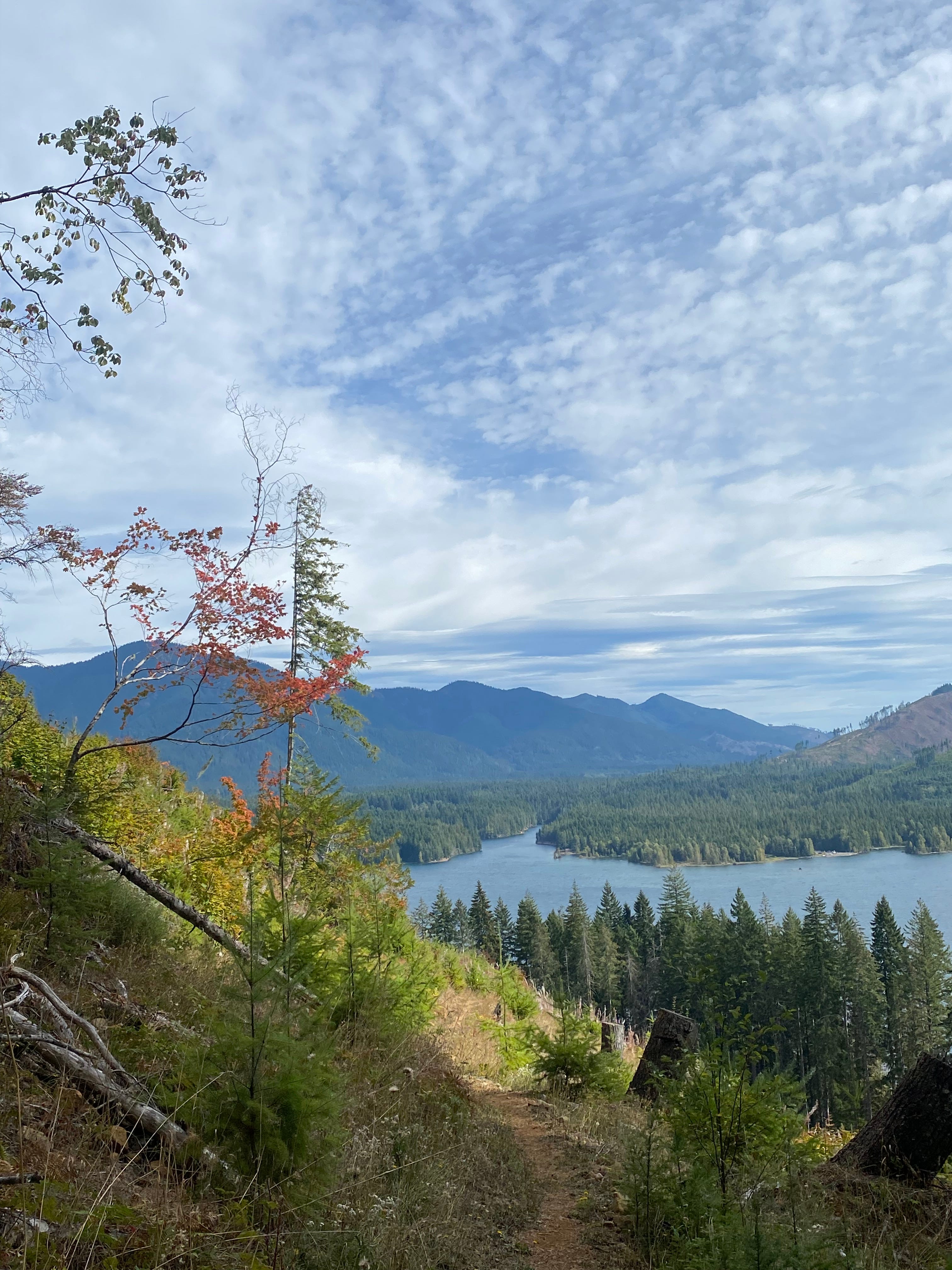
I’ve been tracking this fire for more than two months now, but it wasn’t until I looked out at the sky on this particular evening that I felt a deep pang of—fear? anger? perhaps guilt? that resounded in my chest. Like my father before me, I had the privilege of growing up on the shores of Lake Cushman. Those waters raised me. Those forests have held me. Those mosses have transported me to magical realms. I didn’t recognize it as a child, but recognize now that what years of familiarity and playfulness in these woods gifted me was a relationship with the land. Perhaps I knew as a very small child that it was a sacred place (as all forests are), but at some point I forgot. I reduced it to merely something pretty, a spectacle that would always exist. I failed to remember that it too, breathes. And it too, can die.
I am grieving for this forest and for the decimation of her flora and fauna. Interestingly, though my logical brain knew about this fire for some weeks, it wasn’t til I could see and smell its smoke that the grief became truly palpable. The sensorial experience of the fire is what made the deepest impact on me. It reminded me that sometimes just knowing is not enough. Sometimes we must experience.
This also got me thinking about the folks sitting in penthouses and mansions with limited proximity to the real suffering of land and people that is so pervasive in American society. It got me thinking about family members of mine whose bootstrap theories and far-right beliefs are firm as they are primarily because it’s all they’ve ever known. The damn echo-chamber is a beast. It got me thinking about how cruel Western individualism is—sanctioning us to our single family homes and isolated livelihoods—because as much as I’d like to blame everything on the rich, they are not the only ones insulated from the reality of suffering that exists all around us. I think we are all somewhat complicit, so caught up in our own survival that we avert our gaze from the suffering of our own communities and environments.
Further, in this age of what Jenny Odell refers to in How to do Nothing as “the attention economy”, we are all patrons being constantly marketed to by corporations that stand to profit from keeping us distracted and numbed out to the realities that exist beyond shiny billboards and flashy pixels. If we opened our eyes and truly felt the pain of our neighbors, we might just be inspired to do something about it.
So then, how do we get people to feel? How do we get people to see and smell the smoke? How do we draw each other into genuine sensorial experience?
In the case of my conservative family members, I hoped that coming out as queer would shift something for them. I hoped it would personalize their politics—that they’d begin to recognize that the beliefs they hold have a direct impact on someone they claim to love and cherish. They’ve known queer people exist. It is my hope to draw them into experience by sharing my most authentic self with them.
Another impactful practice in sensation for me lately has been putting my phone away. I am currently on an instagram hiatus after recognizing that my scrolling had become compulsive and was skewing my perception of reality. While I appreciate many of the functions social media can serve, I desperately want to be where my feet are. I’ve also been taking phoneless walks with my dog and trying to gain more familiarity with the natural environment around me. I greet the trees and identify the birds. Stellar Jay. Californian Scrub Jay. Robin. I lean over to smell the roses and rosemary that garnish my neighborhood. I stop and chat with the Real Change News sellers on street corners. I desire to be an experiential member of the physical and social ecosystem I inhabit.
While I’m still heartbroken for all the loss due to Bear Gulch Fire, I am grateful to the smoke for bringing me a fresh awareness of how finite all this is. Fires and fascism and other catastrophes are genuine threats. While that is a terrifying reality, recognizing the finiteness of all that I love has encouraged me into deeper presence with and gratitude for it. And it’s lit a fire under my ass (pun intended) to resist numbness and consciously disrupt destructive systems. Experiencing is powerful. May we keep our senses open to the transformation that happens when we feel.
I’d love if you’d comment your thoughts on knowledge versus experience below. What practices draw you into feeling? How have you noticed sensorial experience shift your perspective on certain matters? Do you think proximity to suffering increases empathy?
As always, I send such gratitude to you for your presence here,
<3 Kenz
READING: Good Girl and Other Yearnings by none other than substack’s very own Isabelle Correa. One of my favorite things about her poetry is how it locates her within relationships. A sister. A daughter. A lover. For better or worse and sometimes both. A stunning collection.
I’m also reading (well, listening on Libby) Becoming Kin: An Indigenous Call to Unforgetting the Past and Reimagining Our Future by Patty Krawec. It’s really intriguing to hear the author discuss the similarities and differences between Indigenous traditions and the Christian tradition that was prescribed to them during colonization. It’s also inspired me to trace back some of my own ancestry.
LISTENING TO: Magdalena Bay! They are some of my favorite artists and I had the privilege of seeing them in concert this week thanks to a dear friend of mine who had an extra ticket. I’m not going to embed a spotify link this time because I recently switched to Tidal after learning that spotify’s ceo invested millions in an AI military startup… A hard transition for enthusiastic playlist creators like myself but so worth it for the sake of divestment!!
Anyway! Listen to Death & Romance by Magdalena Bay!
This is such a beautiful post, and I resonate with so much of it. This summer I’ve also been taking walks without my phone, and it’s been such a nice practice of presence. I feel more connected to my body and community…so needed in these times.
I really appreciate this post. It made me think about some of the small protests I've been seeing in my local community. A women who hosts a letter writing event every Sunday. A group that protests on a street corner every Wednesday. I think this has been the experience for me. It's like, this is something real and tangible I can do. This is gaining momentum. This exist. This is real not just on social media or in the news. As you said, it's where my feet are.